
E-books vs Physical Books: Which Is Better?
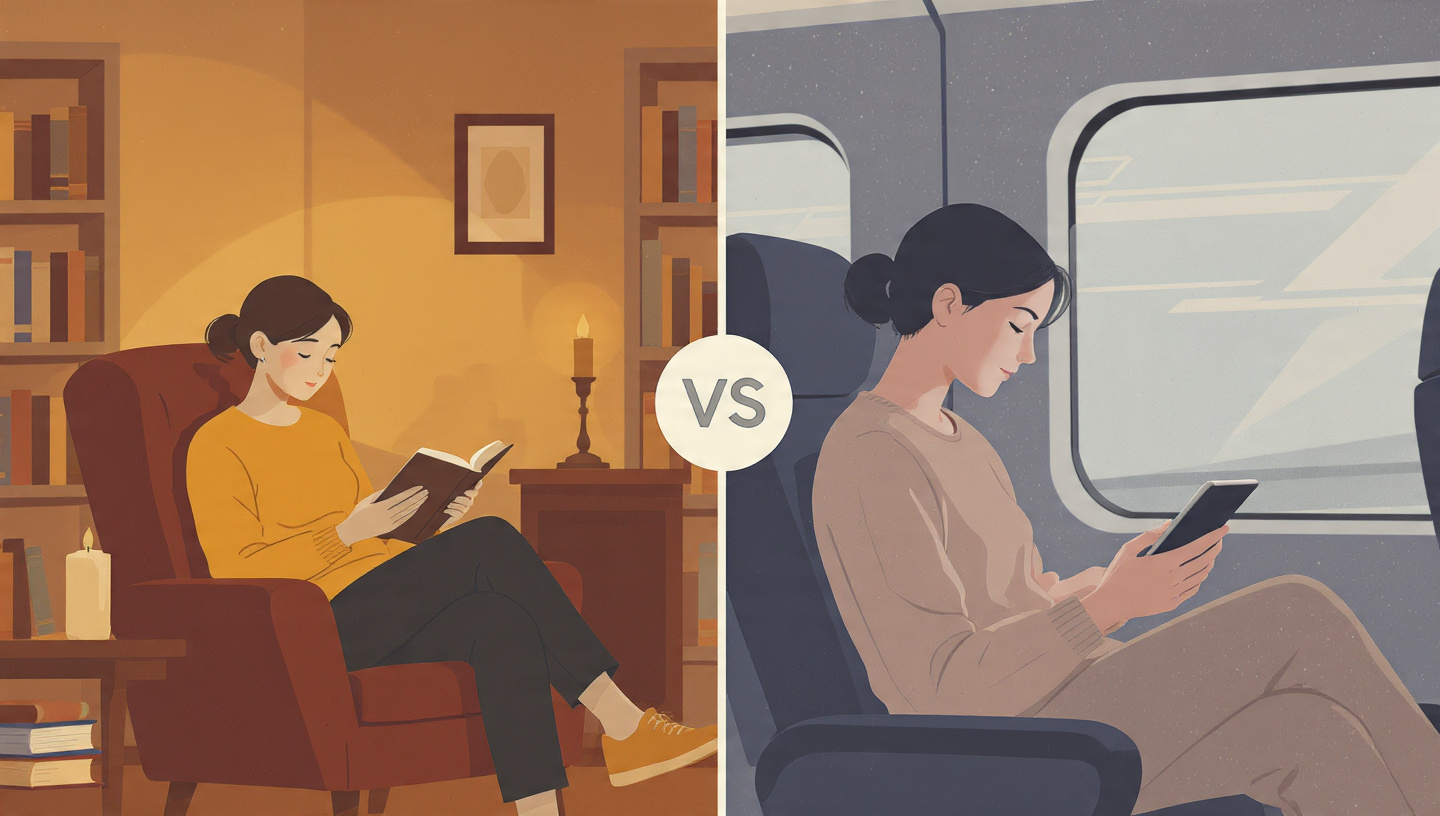
The age-old debate among book lovers — e-books or physical books? Both camps have passionate advocates. The truth is, the answer depends on your reading habits, your lifestyle, and the situation in which you read. In this article, we will compare both formats in depth, reference the research, and help you make the right decision for yourself.
Tactile experience and aesthetics
The moment you pick up a physical book — its weight, the texture of the cover, the smell of fresh paper — no digital device can replicate that. Psychologists call this haptic advantage: physical contact with the material world activates the brain differently. Building a bookshelf, filling a favourite book with dense underlines, collecting signed copies — all of these are deep aesthetic pleasures that only a physical book can give. An e-book creates no visual shelf, gives no sense of a growing collection.
Eye health and blue light
Most studies confirm that blue light from screens tires the eyes and, when reading before bed, reduces sleep quality. However, modern e-ink technology (devices like Kindle and Kobo) eliminates almost all of the blue light from standard screens. E-ink displays produce no glare and can be read comfortably even in direct sunlight. The gap between an e-reader and a physical book thus becomes minimal. Reading on a tablet or smartphone screen, however, remains the worst option for eye health.
Focus and reading comprehension
A 2018 Norwegian study (Reading Comprehension Study) found that people understand text more deeply and remember details more reliably when reading on paper. The reason: the physical position of information on a page ('this idea was at the top of the left-hand page') anchors memory more firmly. On an e-book, everything looks the same, which can make retention harder. That said, for sustained long-form reading both formats work — it is largely a matter of habit.
Portability and convenience
In this category, e-books have no competition. You can carry hundreds or even thousands of books on a single device. International travel, waiting in the metro, a lunch break — your library is always ready. Physical books, especially thick novels, can be heavy and bulky. And once you finish a book while travelling, getting the next one requires planning ahead.
Instant access
A new release from an author like George Orwell lands — you can download the e-book and start reading within seconds. A physical book requires placing an order and waiting 1–3 days, even with fast delivery.
Search, annotation, and highlighting
One of the e-book's greatest strengths is its digital features. Full-text search, word highlighting, note-taking, instant dictionary lookup — all at a single tap. Physical books offer the same capabilities, but manually: drawing lines with a pencil, sticking bookmarks. Some readers love this handcraft quality; for others, digital tools are simply more productive.
Environmental impact
Publishing a physical book consumes forests, water, and energy. An e-reader is manufactured once and stores thousands of books. At first glance, digital reading looks greener. However, device manufacturing (rare earth elements, battery production) also leaves a significant ecological footprint. Research suggests that you 'break even' environmentally after reading roughly 40–50 books on an e-reader — before that, physical books cause less environmental damage.
Cost comparison
E-books are generally cheaper — in most cases 30–50% less than print editions. The initial investment in an e-reader (the equivalent of 100–200 AZN) seems large, but over time the savings are real. Physical books, on the other hand, build a tangible collection, can be given as gifts, and can be resold secondhand.
Audiobooks — the third option
In the debate between paper and electronic, we often forget the third format: audiobooks. While exercising, driving, or cooking — when your hands are occupied — audiobooks let you keep reading. Some readers combine all three formats: audiobooks during the day, physical books in the evening, e-books while travelling.
When to choose which format?
- Choose physical: Classic novels, relaxation reading, bedtime reading, gifting, building a collection
- Choose e-book: Travel, non-fiction and business books, rapidly switching genres, night reading (e-ink)
- Choose audiobook: Physical activity, long commutes, multilingual learning
The future of reading
As technology advances, the advantages of e-books will grow. But predictions of the death of the physical book have not come true. Over the past decade, print book sales have remained stable and have grown in some categories. The reality is that both formats will coexist. The smart reader uses each one where it belongs.
Discover the best of fiction literature
Find world classics in any format — print or digital — at Kampus Bookstore
Browse fiction →